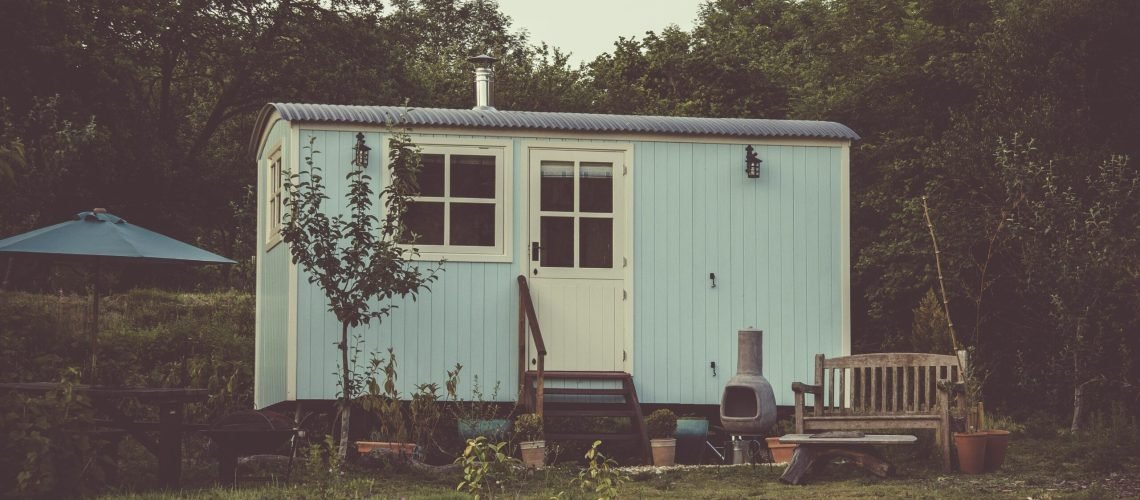
The UK short-break market has never offered more variety. Among the options that have grown most quickly over the past decade are tiny cabins and shepherd huts, two categories that often get grouped together on booking platforms but that offer meaningfully different experiences. For anyone trying to decide between them, it helps to understand what each actually is and where the differences lie.
What is a tiny cabin?
The term “tiny cabin” covers a broad range of structures. At the lower end, it describes a compact timber-framed room, often a garden room or glamping pod that has been fitted out with a bed and a basic kitchen. At the higher end, it might describe a purpose-built Scandinavian-influenced structure with full insulation, underfloor heating, and floor-to-ceiling glazing.
What most tiny cabins share is a fixed foundation. They sit on concrete bases or decking, which gives them a stable footprint and, in well-built examples, excellent thermal performance. Many are designed to feel like a scaled-down version of a contemporary house, with clean lines, large windows, and a minimalist interior. The aesthetic is typically modern, and the experience leans toward architectural rather than pastoral.
Because they are fixed structures, tiny cabins often require planning permission. Operators on holiday let sites typically hold the relevant consents, but for someone considering putting a cabin on their own land, the planning position is generally more complex than for a mobile structure.
What is a shepherd hut?
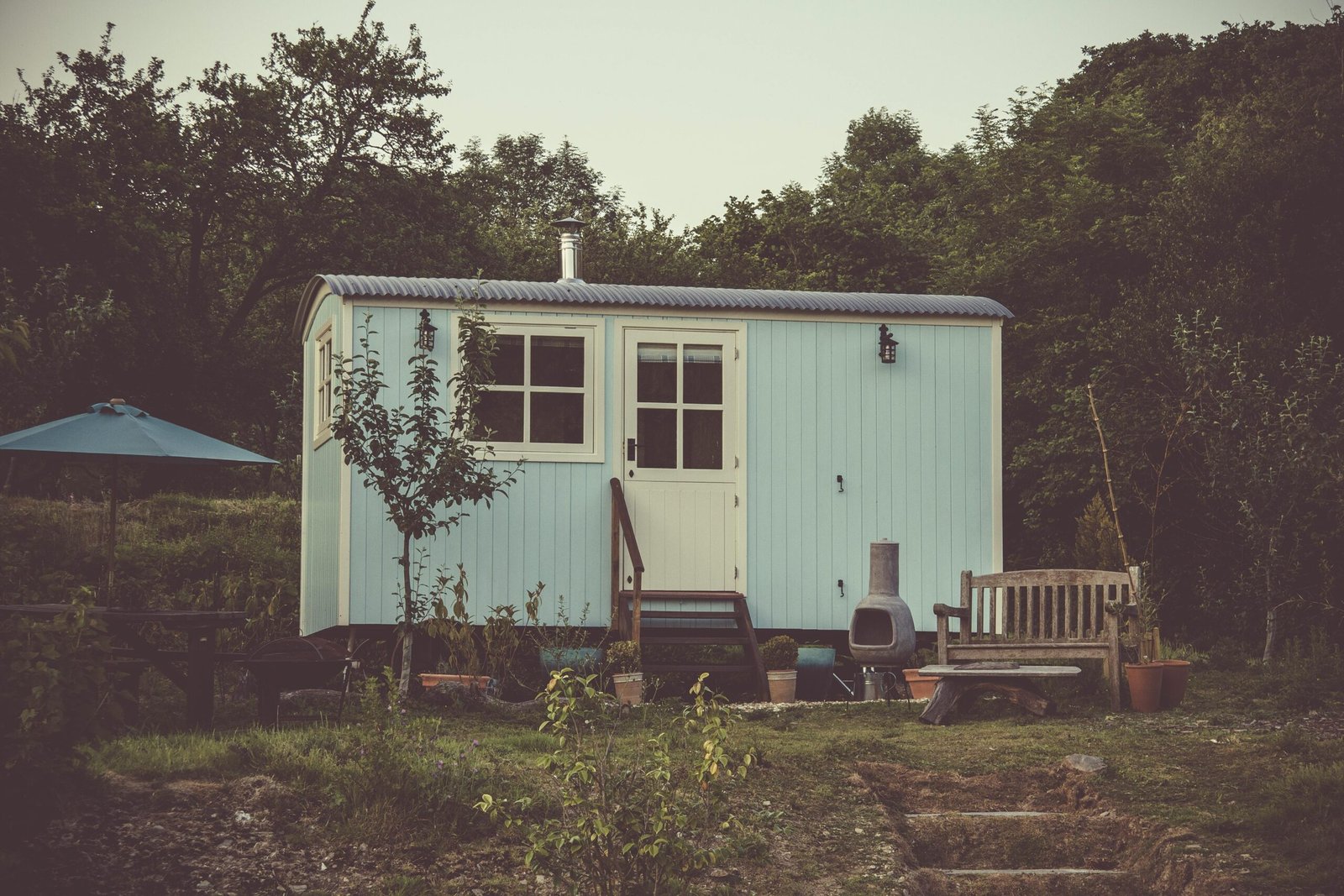
A shepherd hut is a mobile structure built on a heavy steel chassis with wheels. The form dates to the nineteenth century, when working shepherds needed somewhere to shelter during lambing season, away from the farmhouse but close to the flock. Contemporary shepherd huts retain that chassis and those wheels but are built to a much higher specification than their predecessors.
The key physical difference from a tiny cabin is the profile: a shepherd hut has a curved or apex roof, corrugated steel cladding, and sits higher off the ground on its chassis. The interior proportions are narrower than a cabin but longer, which creates a distinct spatial quality, something more like a railway carriage than a room. That narrowness is, for many guests, part of the appeal.
A well-built shepherd hut is fully insulated for year-round use and can include a wood-burning stove, electric underfloor heating, an en-suite shower room, and a kitchenette. The quality of the fit-out varies significantly between manufacturers, and the difference between a basic and a premium hut is immediately apparent in person.
Because they sit on wheels and are classified as mobile structures under the Caravan Sites Act 1960, shepherd huts occupy a different legal category from permanent buildings, which can give site owners more flexibility when it comes to planning.
How do the two experiences compare?
The most obvious difference is atmosphere. A tiny cabin, particularly a contemporary one, tends to feel clean, light, and architectural. A shepherd hut tends to feel warmer, more textural, more deliberately removed from the modern world. The corrugated steel, the oak joinery, the curved ceiling, the wood-burning stove: these elements create an environment that feels considered rather than designed. Neither is objectively better. They appeal to different moods and different types of traveller.
Space is the second consideration. Tiny cabins are often wider, which makes it easier to include a full bathroom, a dining area, and a proper kitchen. A shepherd hut in the 18ft range can accommodate all of those things, but the layout is more linear, which requires more thought from the designer. On a well-planned hut, that constraint produces something interesting. On a poorly planned one, it produces compromise.
The setting matters more with a shepherd hut than with a tiny cabin, partly because the hut itself signals a particular kind of landscape. A shepherd hut on a working farm, at the edge of a wood, or in the corner of a meadow looks as though it belongs. The same hut on a concrete pad in a caravan park does not. Tiny cabins are somewhat more adaptable to different contexts, particularly modern rural tourism sites where the surrounding landscape is the draw rather than the accommodation itself.
On cost, the two are broadly comparable for a night’s stay. Well-positioned shepherd huts and quality cabins in similar locations tend to command similar nightly rates, typically between £120 and £250 depending on season, location, and specification. Reviews and photography drive occupancy in both categories more than the structure type alone.
Which suits a minibreak better?
That depends on what the break is for. Someone who wants to disconnect, slow down, and feel the difference between inside and outside, the sound of rain on a corrugated steel roof is a specific and irreplaceable thing, tends to find a shepherd hut more satisfying. Someone who wants comfort, light, and a space that feels like a considered escape from a city flat often responds better to a well-designed cabin.
Both are a significant step up from a hotel room. The defining feature of either, when done well, is the sense of having your own place, however temporarily. That is what people are paying for, and it is what the best examples of both deliver.